

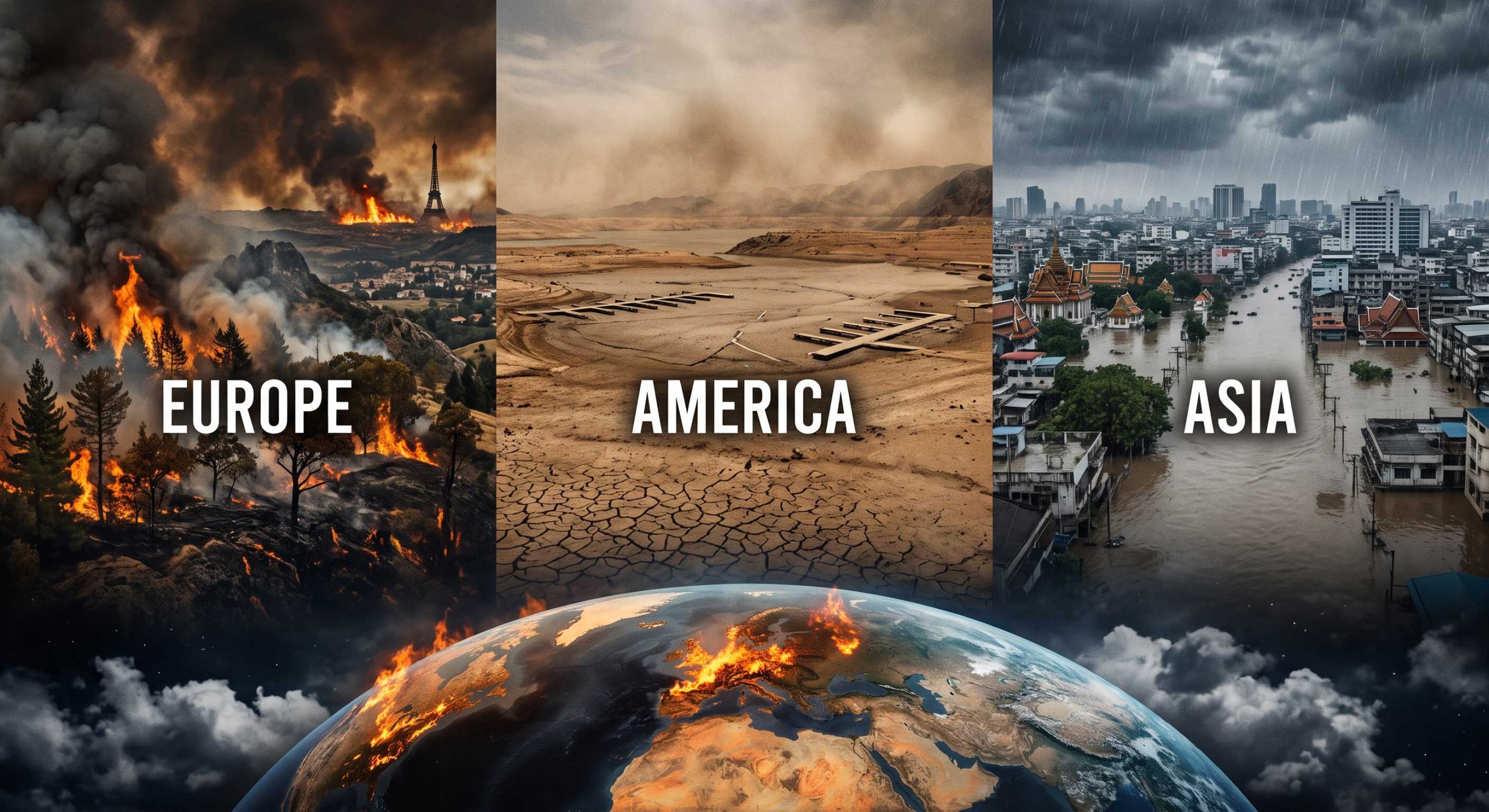
Europe is burning, America is drying up and Asia is underwater. The carefree summer escape may be another casualty of climate change.
For most of my life, summer holidays have meant escape. Long days, blue skies, warm seas and the slightly delusional belief that normal life can be suspended for a few weeks.
But the images coming out of this summer are becoming difficult to square with that fantasy.
Tourists are being evacuated from beaches beneath orange skies. European cities are baking through one heatwave after another. Across the American West, reservoirs are sinking towards levels that once seemed unthinkable. Meanwhile, huge parts of Asia are dealing with the other side of the same crisis: far too much water arriving all at once.
It’s starting to feel as though our idea of summer belongs to a climate that no longer exists.
That doesn’t mean nobody will go on holiday. Of course we will. But the promise of a predictable, carefree summer is beginning to look seriously outdated.
The Mediterranean is losing its innocence

The European summer has been one of the most successful lifestyle brands ever created.
The formula hasn’t changed much: a beach in Greece, a villa in Provence, a long lunch somewhere in Italy, perhaps a cold bottle of rosé. Millions of people build their year around those few weeks.
This summer, the picture looks rather different.
Western Europe recorded its hottest June on record in 2026. The average temperature reached 20.74°C, more than three degrees above the 1991–2020 June average. Europe as a whole experienced its second-hottest June, according to the Copernicus Climate Change Service.
The heat had already arrived unusually early. Portugal, the UK and Ireland provisionally recorded their highest May temperatures, while France experienced its hottest May day on record.
By August, Europe was dealing with its fifth heatwave of the year.
It’s tempting to see this as an inconvenience: unpleasant nights, overcrowded beaches and hotel air conditioning struggling to keep up. But heat on this scale reaches into almost every part of daily life.
Hospitals overheat. Train lines buckle. Crops fail. Rivers become too shallow for shipping or too warm to cool power stations. Outdoor work becomes dangerous, particularly for the people cleaning hotels, building roads, harvesting food and fighting the fires.
Europe is also remarkably poorly equipped for sustained heat. Only about 20% of European households have air conditioning, compared with around 76% in North America.
Swiss Re Institute now describes extreme heat as a “chronic” European risk. That’s a grim word, but an accurate one. This is no longer a freak event from which everything returns to normal. Heat is becoming part of the continent’s operating environment.
Then there are the fires.
Wildfires in France, Spain and Greece may have caused as much as €19.1 billion in damage and economic losses this summer, according to a preliminary estimate reported by Bloomberg.
“As heat in Europe increases, wildfire-conducive conditions are likely to become more frequent,” Swiss Re warned.
We have heard similar warnings for years, but something has shifted. The fire season is getting longer, large fires are becoming more common and the old geographical boundaries are disappearing. Wildfire is no longer confined to the driest parts of southern Europe. France, Germany, Belgium, Britain and Scandinavia are all having to confront the risk.
The Copernicus assessment of Europe’s 2025 fire season found that more than one million hectares burned across the European Union, the largest area in the EU record.
Against this backdrop, the classic Mediterranean holiday starts to feel more complicated.
It’s difficult to relax beside a private pool when local residents are being asked to save water. It’s difficult to think of a pine forest as nothing more than a beautiful view when a single spark could send a fire racing towards nearby towns.
None of this means people should abandon southern Europe. Tourism supports millions of livelihoods. But it does mean we need to be more honest about what is happening there.
The Mediterranean isn’t simply having a bad summer. It’s being reshaped by a hotter climate.
America’s water bank is almost empty

In the American West, the crisis is unfolding more slowly. That may make it even easier to ignore.
Lake Powell, the second-largest reservoir in the United States, has dropped to its lowest recorded level. In August 2026, it reached 3,519.91 feet, according to Bureau of Reclamation data reported by CNN.
That leaves the reservoir less than 30 feet above the “minimum power pool”, the point at which Glen Canyon Dam may no longer be able to generate electricity.
“We are in uncharted territory,” Jack Schmidt, director of the Center for Colorado River Studies at Utah State University, told CNN.
Lake Powell is an extraordinary place. I’ve always been struck by the surreal contrast between its blue water and the red desert surrounding it. But its dramatic white “bathtub ring” now tells another story. It marks the waterline of a reservoir that used to be much fuller.
Downstream, Lake Mead, America’s largest reservoir, has also fallen to a record low.
Together, the two reservoirs hold close to 60% of the water stored across the Colorado River Basin. The river supplies around 40 million people and irrigates more than five million acres of farmland.
It has shrunk by roughly 20% since 2000, driven by rising temperatures, prolonged drought and the inconvenient fact that people have been taking out more water than the system can reliably provide.
Lake Powell was designed as a sort of giant water savings account. Water would be stored in wet years and released during dry ones. The trouble is that the dry years keep coming, while the hotter climate leaves less snow and more water lost to evaporation.
Brad Udall, a senior water and climate scientist at Colorado State University, has described the minimum power level as a “scary threshold”. If the reservoir falls much further, it won’t only affect boating holidays and lakeside businesses. The dam generates enough electricity to power nearly 500,000 homes each year.
Go lower still and Lake Powell eventually approaches “dead pool”, the point at which water can no longer flow downstream through the dam.
Experts don’t believe millions of people are about to turn on their taps and find nothing. Water managers are taking emergency measures, and cities including Phoenix and Tucson have prepared alternative supplies.
But richer cities can afford backup options. Smaller communities and Indigenous nations may not have that luxury.
This is why the bathtub ring matters. It isn’t just a symbol of drought. It shows how climate pressure amplifies the inequalities that were already there.
In Asia, the rain no longer behaves as expected

Asia is experiencing a very different water crisis.
In India’s Assam state, severe monsoon flooding displaced more than 700,000 people in July and August. By August 10, the death toll had reached 100, according to Associated Press reporting. Nearly 300,000 people were forced into relief camps as the Brahmaputra overflowed, flooding villages and farmland.
In Chattogram, Bangladesh, more than 400 millimetres of rain fell within 24 hours in July. It was the city’s highest daily rainfall in more than four decades. Roads disappeared beneath the water, trains were disrupted and neighbourhoods flooded.
Then, in August, record rainfall hit cities east of Tokyo. At least five people died and thousands were stranded. In Sakura, Chiba prefecture, 97 millimetres of rain fell in a single hour, according to figures reported by AP.
During just one week in July, the AHA Centre recorded 18 disasters across Indonesia, the Philippines, Thailand and Vietnam. The list included floods, landslides, storms and drought.
We should be careful here. It isn’t scientifically accurate to blame every flood or storm entirely on climate change. Monsoons have always flooded, and the damage is shaped by deforestation, weak drainage, reckless construction and the loss of wetlands and mangroves.
But warmer air can hold more moisture, while warmer seas provide extra energy to storms. The rain may still be part of a familiar weather system, but it is increasingly arriving in unfamiliar ways: heavier, faster and harder for cities to absorb.
Many Asian cities have expanded by paving over the very landscapes that once held water. Climate change increases the danger, then poor planning makes certain the consequences are worse.
There’s an uncomfortable imbalance in all this.
For wealthy travellers, extreme weather may mean a cancelled flight, a disrupted itinerary or an insurance claim. For the communities where we holiday, it can mean losing a home, a harvest or a family member.
The countries that have contributed least to global emissions are often left facing the greatest damage with the fewest resources.
Travel can’t pretend this is someone else’s problem

Tourism depends on consistency.
The snow comes back every winter. The beach remains where it was. The coral reef stays colourful. The river keeps flowing. Summer is hot, but pleasantly so.
That consistency can no longer be taken for granted.
Ski resorts are moving activities higher up mountains. Mediterranean destinations are promoting spring and autumn travel. Hotels are investing in cooling systems, backup generators, water recycling and fire plans. Insurers are quietly reconsidering which homes and businesses they can afford to cover.
Travellers now need to check wildfire warnings, heat alerts, air quality and flood forecasts as routinely as they check hotel reviews.
The industry also needs to confront its own contribution. Aviation, cruise ships, sprawling resorts, imported food and constant development all add emissions or place further pressure on fragile local environments.
There is something absurd about flying people around the planet to appreciate nature while degrading the conditions that allow it to exist.
That doesn’t mean we should stop travelling. Done well, tourism supports communities, funds conservation and introduces us to people and places we might otherwise never understand.
But “done well” has to mean more than asking guests to reuse their towels.
It might mean travelling outside the hottest months, staying longer and flying less often. It could mean choosing trains for shorter journeys, supporting locally owned businesses and avoiding resorts that consume huge quantities of water in drought-stricken areas.
Governments and tourism companies have bigger responsibilities. We need to stop building hotels and homes in floodplains and fire corridors. Cities require shade, trees, cooler buildings and drainage that can cope with violent rain. Hotels need emergency plans that protect staff as well as guests.
And the industry’s largest companies need to cut emissions in the real world, not simply make them disappear inside a beautifully designed sustainability report.
I’ve spent much of my career trying to reconnect people with the natural world. Travel can play an important role in that. Few things are more powerful than experiencing a wild place for yourself.
But loving nature when it provides a beautiful backdrop is the easy part.
The real test is whether we are prepared to change our behaviour when that same natural world begins showing signs of collapse.
So, is the summer holiday dream over?
Probably not. But the old version of it—built on cheap flights, predictable weather, endless growth and the assumption that paradise will always remain open—is on borrowed time.
We can keep travelling. We should keep exploring. But we need to do it with our eyes open.
Paradise is not a product we’re entitled to consume. It’s a living place, and like any relationship worth keeping, it requires something from us in return.


